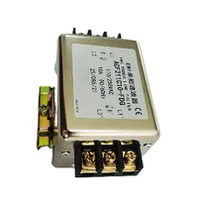
Hey there! As a supplier of 3 PHASE EMC FILTERS, I often get asked about the resonance frequency of these filters. So, I thought I'd take a moment to break it down and explain what it is, why it matters, and how it affects the performance of our 3 PHASE EMC FILTERS.
First off, let's talk about what resonance frequency is. In simple terms, resonance frequency is the frequency at which an object vibrates most easily. When an object is exposed to a frequency that matches its resonance frequency, it will start to vibrate with greater amplitude. This is because the energy being applied to the object is being transferred efficiently, causing it to vibrate more strongly.
In the context of 3 PHASE EMC FILTERS, resonance frequency is the frequency at which the filter's components, such as capacitors and inductors, interact to create a peak in the filter's impedance. This peak in impedance can cause the filter to become less effective at filtering out electromagnetic interference (EMI) at that specific frequency.
So, why does resonance frequency matter? Well, if the resonance frequency of a 3 PHASE EMC FILTER falls within the frequency range of the EMI that the filter is designed to block, it can lead to a significant reduction in the filter's performance. This can result in increased EMI emissions from the equipment being filtered, which can cause interference with other electronic devices and systems.
To avoid this problem, it's important to choose a 3 PHASE EMC FILTER with a resonance frequency that is outside of the frequency range of the EMI that the filter is designed to block. This can be achieved by carefully selecting the filter's components and designing the filter to have a flat frequency response across the desired frequency range.
At our company, we take resonance frequency very seriously. We use advanced design techniques and high-quality components to ensure that our 3 PHASE EMC FILTERS have a resonance frequency that is well outside of the frequency range of the EMI that they are designed to block. This helps to ensure that our filters provide reliable and effective EMI filtering performance in a wide range of applications.
Now, let's take a closer look at how resonance frequency affects the performance of 3 PHASE EMC FILTERS. When a 3 PHASE EMC FILTER is exposed to EMI at a frequency that matches its resonance frequency, the filter's impedance will increase significantly. This increase in impedance can cause the filter to become less effective at filtering out the EMI, as the EMI will be able to pass through the filter more easily.
In addition to reducing the filter's effectiveness at filtering out EMI, resonance frequency can also cause the filter to generate its own EMI. This is because the increased impedance at the resonance frequency can cause the filter's components to vibrate, which can generate electromagnetic waves. These electromagnetic waves can then interfere with other electronic devices and systems, causing further problems.
To minimize the effects of resonance frequency on the performance of our 3 PHASE EMC FILTERS, we use a variety of techniques. One of these techniques is to use damping resistors in the filter's design. Damping resistors help to reduce the amplitude of the vibrations at the resonance frequency, which can help to prevent the filter from generating its own EMI.
Another technique that we use is to design the filter to have a wide bandwidth. A wide bandwidth means that the filter is able to filter out EMI over a wider range of frequencies, which can help to reduce the likelihood of the resonance frequency falling within the frequency range of the EMI that the filter is designed to block.
In addition to these techniques, we also perform extensive testing on our 3 PHASE EMC FILTERS to ensure that they meet the highest standards of performance and reliability. We use state-of-the-art testing equipment and techniques to measure the filter's performance at a variety of frequencies and under different operating conditions. This helps us to identify any potential issues with the filter's design or performance and to make any necessary adjustments to ensure that the filter provides optimal EMI filtering performance.


Now, let's talk about some of the different types of 3 PHASE EMC FILTERS that we offer. We offer a wide range of 3 PHASE EMC FILTERS, including 4-line Filters, 2-line Filters, and 3 Phase Filter. Each of these filters is designed to meet the specific needs of different applications and industries.
Our 4-line Filters are designed to provide high-performance EMI filtering for three-phase power systems. These filters are typically used in industrial applications, such as motor drives, power supplies, and variable frequency drives. Our 4-line Filters are available in a variety of configurations and ratings to meet the specific needs of different applications.
Our 2-line Filters are designed to provide cost-effective EMI filtering for single-phase power systems. These filters are typically used in residential and commercial applications, such as lighting, appliances, and electronics. Our 2-line Filters are available in a variety of configurations and ratings to meet the specific needs of different applications.
Our 3 Phase Filter are designed to provide high-performance EMI filtering for three-phase power systems. These filters are typically used in industrial applications, such as motor drives, power supplies, and variable frequency drives. Our 3 Phase Filter are available in a variety of configurations and ratings to meet the specific needs of different applications.
In conclusion, resonance frequency is an important factor to consider when choosing a 3 PHASE EMC FILTER. By understanding what resonance frequency is, why it matters, and how it affects the performance of 3 PHASE EMC FILTERS, you can make an informed decision when selecting a filter for your application. At our company, we are committed to providing high-quality 3 PHASE EMC FILTERS that are designed to meet the specific needs of different applications and industries. If you have any questions or would like to learn more about our products, please don't hesitate to contact us. We'd be happy to help you find the right filter for your needs.
References
- Some basic electrical engineering textbooks on filter design and electromagnetic compatibility.
- Industry whitepapers on the performance and application of 3 PHASE EMC FILTERS.