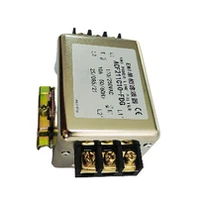
What is the maximum current that 4 - line Filters can withstand?
As a respected supplier of 4 - line Filters, I've noticed an increasing curiosity among our customers regarding the maximum current these filters can withstand. This is a legitimate concern, as understanding current capacity is crucial when integrating these filters into electrical systems. In this blog, we'll delve deep into the factors affecting the maximum current tolerance of 4 - line Filters, explore how it is determined, and discuss its significance in various applications.
Factors Affecting the Maximum Current of 4 - line Filters
The maximum current that a 4 - line Filter can withstand is influenced by several key factors. First and foremost is the material used in the filter's construction. The conductors inside the filter play a pivotal role. Copper is a commonly used material due to its excellent electrical conductivity. However, the gauge of the copper wire matters significantly. Thicker wires can handle more current because they offer less resistance. Resistance is directly related to heat generation; as current flows through a conductor, power is dissipated as heat according to the formula (P = I^{2}R), where (P) is power (in watts), (I) is current (in amperes), and (R) is resistance (in ohms). A lower - resistance wire will produce less heat for a given current, allowing the filter to handle higher currents without overheating.
Another critical factor is the design of the filter's core. In many 4 - line Filters, magnetic cores are used to enhance the filtering performance. The type of core material and its size also impact the current - handling capacity. For example, ferrite cores are popular due to their high magnetic permeability, which helps in suppressing electromagnetic interference (EMI). However, ferrite cores have a saturation limit. When the current flowing through the filter is too high, the magnetic core can saturate, losing its ability to function effectively. A larger core size can generally handle higher magnetic fluxes and thus higher currents before saturation occurs.
The environment in which the filter is used also plays a role. Temperature is a significant environmental factor. As the temperature rises, the resistance of the conductors inside the filter increases. This increased resistance leads to more heat generation for a given current, which can push the filter closer to its maximum operating temperature. Filters designed for high - temperature environments typically have better insulation and heat - dissipating properties, allowing them to handle higher currents. Humidity and dust can also affect the performance of the filter. Moisture can cause corrosion of the conductors, increasing resistance and reducing the current - handling capacity. Dust accumulation can insulate the filter and prevent proper heat dissipation.
Determination of the Maximum Current Rating
Manufacturers determine the maximum current rating of 4 - line Filters through a combination of theoretical calculations and practical testing. On the theoretical side, engineers use electrical and magnetic principles to model the behavior of the filter's components. They calculate the resistance of the conductors, the magnetic properties of the cores, and the expected heat generation under different current loads.
Practical testing is equally important. Filters are subjected to a series of tests in a controlled environment. The test setup typically includes a power supply that can vary the current flowing through the filter. Sensors are used to monitor the temperature of the filter, the voltage across its terminals, and the impedance. The current is gradually increased until the filter reaches its maximum operating temperature or until the performance starts to degrade significantly. This maximum current value is then adjusted to provide a safety margin and is specified as the maximum current rating in the product datasheet.


Significance in Various Applications
In industrial applications, 4 - line Filters are often used in power distribution systems and motor control units. In these settings, the current requirements can be quite high. For example, large motors can draw hundreds of amperes during startup. A 4 - line Filter with an appropriate maximum current rating is essential to ensure the proper functioning of the motor and to protect the electrical system from EMI. If the filter cannot handle the current, it can overheat, leading to a reduction in its filtering effectiveness and potentially causing damage to the connected equipment.
In telecommunications, 4 - line Filters are used in signal processing units. While the currents in these applications are generally lower compared to industrial applications, the purity of the signal is of utmost importance. A filter that can handle the required current without introducing additional noise or distortion is crucial for maintaining a high - quality signal. The maximum current rating also affects the long - term reliability of the filter. A filter operating close to its maximum current rating is more likely to experience premature failure, which can disrupt communication networks.
Comparison with Other Types of Filters
Let's briefly compare 4 - line Filters with some other common types of filters. The 3 Phase Emc Filter is designed specifically for three - phase electrical systems. These filters are capable of handling high currents, often in the range of tens or even hundreds of amperes. They are typically used in industrial power distribution and large - scale electrical equipment. In contrast, 4 - line Filters are more versatile and can be used in both single - phase and multi - phase systems. While they may not have the same high - current capacity as some 3 - phase filters, they are more suitable for applications where space is limited or where a combination of power and signal filtering is required.
The Signal Line Filter is primarily used for filtering low - level signals. These filters are designed to handle very low currents, usually in the milliampere or microampere range. Their main function is to remove unwanted noise from the signal while maintaining the integrity of the original signal. 4 - line Filters, on the other hand, can handle both power - related currents and signal - related currents, making them more suitable for applications where both power and signal handling are necessary.
The 3 Phase Filter is another type of filter commonly used in three - phase systems. Similar to the 3 Phase Emc Filter, it is designed to handle high currents. However, 3 Phase Filters may have different filtering characteristics and construction compared to 4 - line Filters. 4 - line Filters offer more flexibility in terms of system integration and can be used in a wider range of applications.
Conclusion and Call to Action
In conclusion, understanding the maximum current that 4 - line Filters can withstand is crucial for anyone looking to integrate these filters into an electrical system. It is affected by factors such as the materials used, the design of the filter, and the operating environment. The maximum current rating is determined through a combination of theoretical calculations and practical testing.
Whether you are involved in industrial applications, telecommunications, or other fields where electrical filtering is required, choosing the right 4 - line Filter with an appropriate maximum current rating is essential for ensuring the reliable operation of your equipment and the quality of your electrical signals.
If you are interested in purchasing 4 - line Filters or have any questions about their current - handling capacity, please don't hesitate to reach out. Our team of experts is ready to provide you with detailed information and assist you in selecting the best filter for your specific needs. Contact us today to start the procurement process and experience the high - quality performance of our 4 - line Filters.