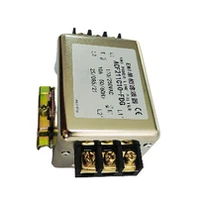
What is the difference between passive and active 3 PHASE EMC FILTER?
As a professional supplier of 3 PHASE EMC FILTER, I've been frequently asked about the difference between passive and active 3 PHASE EMC FILTER. To provide a comprehensive understanding, this article will delve into the characteristics, working principles, pros, and cons of these two types of filters.
Understanding the Basics of 3 PHASE EMC FILTER
Before we dive into the differences, it's essential to understand what a 3 PHASE EMC FILTER is. A 3 PHASE EMC FILTER is a device designed to mitigate electromagnetic interference (EMI) in three - phase electrical systems. Three - phase power systems are widely used in industrial machinery, commercial buildings, and large electrical equipment, where a stable and interference - free power supply is crucial. For more information on 3 Phase EMC Filter, you can visit 3 Phase Emc Filter.
Passive 3 PHASE EMC FILTER
Passive 3 PHASE EMC FILTERs are the most commonly used type of filters in the market. They consist of passive components such as inductors, capacitors, and resistors. These components work together to block or divert unwanted electromagnetic signals while allowing the desired power frequency to pass through.
-
Working Principle
- The inductor in a passive filter resists changes in current. By increasing the impedance at high frequencies, it effectively blocks high - frequency EMI from passing through the circuit.
- Capacitors, on the other hand, act as short - circuits for high - frequency signals. They shunt the unwanted high - frequency noise to the ground, preventing it from reaching the load.
- Resistors are used to dampen oscillations and control the filter's impedance matching.
-
Advantages
- Cost - effective: The components used in passive filters are relatively inexpensive, making them a cost - efficient solution for many applications.
- Reliability: Since there are no active components, such as integrated circuits, passive filters are less prone to failure. They have a long service life and can operate under harsh environmental conditions.
- No external power required: Passive filters do not need an external power source to function. They can be directly installed in the electrical circuit without any additional power supply.
-
Disadvantages
- Limited performance: Passive filters have a fixed filtering characteristic. They are designed for a specific frequency range and may not be able to adapt to changing EMI conditions.
- Large size: The inductors and capacitors used in passive filters are relatively large, especially for high - power applications. This can increase the overall size and weight of the equipment.
Active 3 PHASE EMC FILTER
Active 3 PHASE EMC FILTERs incorporate active components, such as operational amplifiers and integrated circuits, in addition to passive components. These active components enhance the filter's performance and flexibility.
-
Working Principle
- An active filter uses an active component to sense the EMI signals and generate a counter - signal with the same amplitude but opposite phase. This counter - signal is then injected into the circuit to cancel out the unwanted EMI.
- The active component can also adjust the filter's gain and frequency response in real - time, allowing the filter to adapt to different EMI conditions.
-
Advantages


- High performance: Active filters can provide a much higher level of EMI suppression compared to passive filters. They can effectively eliminate EMI across a wide frequency range.
- Flexibility: The performance of active filters can be easily adjusted by changing the settings of the active components. This allows the filter to adapt to different electrical systems and EMI environments.
- Small size: Active filters can achieve the same level of filtering performance as passive filters with a smaller physical size, which is beneficial for space - constrained applications.
-
Disadvantages
- Higher cost: The active components used in active filters are more expensive than passive components. This makes active filters a more costly option, especially for large - scale applications.
- Power consumption: Active filters require an external power source to operate. This not only adds to the overall power consumption of the system but also requires additional wiring and power management.
- Complexity: The design and implementation of active filters are more complex than passive filters. They require more expertise in electronics and control theory.
Application Scenarios
The choice between passive and active 3 PHASE EMC FILTER depends on the specific application requirements.
-
Passive Filter Applications
- Low - cost applications: In applications where cost is a major concern, such as small - scale industrial equipment and consumer electronics, passive filters are often the preferred choice.
- Stable EMI environments: If the EMI environment is relatively stable and the frequency range of the interference is known in advance, passive filters can provide a cost - effective solution.
-
Active Filter Applications
- High - performance applications: In high - end industrial equipment, medical devices, and aerospace applications, where a high level of EMI suppression is required, active filters are more suitable.
- Dynamic EMI environments: For applications where the EMI environment changes frequently, such as in some electrical testing facilities, active filters can adapt to these changes and provide consistent filtering performance.
Conclusion
In summary, both passive and active 3 PHASE EMC FILTERs have their own unique characteristics and applications. Passive filters are cost - effective, reliable, and do not require an external power source, but they have limited performance and a larger size. Active filters, on the other hand, offer high performance, flexibility, and a smaller size, but they are more expensive, consume more power, and are more complex.
As a professional 3 PHASE EMC FILTER supplier, we can provide you with a wide range of options to meet your specific needs, whether it's a passive or an active 3 PHASE EMC FILTER. If you are interested in learning more about our 3 Phase Filter or Signal Line Filter products, or if you have any requirements for EMI filtering solutions in your electrical systems, please feel free to reach out to us. We are more than happy to discuss your project and provide you with the most suitable products and solutions.