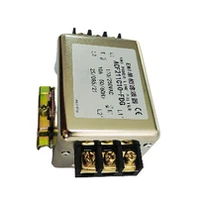
Hey there! As a supplier of 2 - line Filters, I'm super stoked to break down how these nifty little devices work. You might be wondering, "What on earth are 2 - line Filters, and why do I need them?" Well, stick around, and I'll give you the lowdown.
First things first, let's understand what we're dealing with. 2-line Filters are a type of electromagnetic interference (EMI) filter. EMI is basically the unwanted noise or interference that can mess up the normal operation of electronic devices. You know how sometimes your radio gets all staticky, or your TV has those annoying snowflakes? That's EMI at work.
2 - line Filters are designed to tackle this issue by allowing the desired electrical signals to pass through while blocking out the unwanted EMI. They're commonly used in a wide range of electronic equipment, from small consumer gadgets to large industrial machinery.
So, how do they actually work? Well, it all comes down to the basic principles of electricity and magnetism. Inside a 2 - line Filter, there are a few key components: capacitors and inductors.
Capacitors are like little storage units for electrical charge. They consist of two conductive plates separated by an insulating material. When an alternating current (AC) signal passes through a capacitor, it stores and releases the electrical charge in a way that helps to smooth out the signal. In the context of a 2 - line Filter, capacitors are used to shunt the unwanted high - frequency EMI to the ground. They act as a short - circuit for high - frequency signals, allowing them to bypass the sensitive electronic components in the device.
Inductors, on the other hand, are coils of wire. When an electric current flows through an inductor, it creates a magnetic field around the coil. This magnetic field resists changes in the current flow. In a 2 - line Filter, inductors are used to block high - frequency EMI. They act as a high - impedance element for high - frequency signals, preventing them from passing through to the rest of the circuit.
Let's take a closer look at how these components work together. When an electrical signal enters the 2 - line Filter, it first encounters the capacitors. The capacitors start to do their thing, shunting the high - frequency EMI to the ground. The remaining signal then passes through the inductors. The inductors further block any remaining high - frequency components, allowing only the low - frequency, desired signal to pass through to the output of the filter.
It's kind of like a bouncer at a club. The capacitors are like the first line of defense, quickly identifying and kicking out the troublemakers (high - frequency EMI). The inductors are like the more thorough security guards, making sure that no unwanted guests slip through the cracks.
One of the great things about 2 - line Filters is their simplicity and effectiveness. They're relatively easy to install and can provide a significant improvement in the performance of electronic devices. Whether you're dealing with a noisy power supply or interference from nearby electronic equipment, a 2 - line Filter can help to clean up the signal and ensure that your device operates smoothly.
Now, you might be thinking, "Are there different types of 2 - line Filters?" The answer is yes! There are various configurations and ratings available to suit different applications. For example, some 2 - line Filters are designed for use in low - voltage applications, while others are suitable for high - voltage systems.
Another important consideration is the frequency range that the filter is designed to block. Different types of EMI can occur at different frequencies, so it's crucial to choose a filter that is optimized for the specific type of interference you're dealing with.
In addition to 2 - line Filters, we also offer other types of EMI filters, such as 3 Phase Ac Filter and Shielded Room Filters. 3 Phase Ac Filters are used in three - phase electrical systems, which are commonly found in industrial applications. They're designed to handle the higher power levels and more complex electrical waveforms associated with three - phase power.
Shielded Room Filters, on the other hand, are used in shielded enclosures or rooms. These rooms are designed to block out external EMI and provide a controlled electromagnetic environment. Shielded Room Filters are essential for ensuring that the electrical systems inside the shielded room are not affected by external interference.
So, if you're in the market for an EMI filter, whether it's a 2 - line Filter, a 3 Phase Ac Filter, or a Shielded Room Filter, we've got you covered. Our filters are made with high - quality components and are rigorously tested to ensure their performance and reliability.
We understand that every application is unique, and that's why we offer a range of customization options. Whether you need a filter with specific electrical ratings, physical dimensions, or mounting options, we can work with you to create a solution that meets your exact requirements.
If you're interested in learning more about our 2 - line Filters or any of our other EMI filter products, don't hesitate to reach out. We're always happy to answer your questions and provide you with more information. Whether you're a small business owner looking to improve the performance of your electronic equipment or a large industrial manufacturer in need of high - quality EMI filters, we're here to help.


Contact us today to start a conversation about your EMI filtering needs. We're confident that we can provide you with the right solution at the right price. Let's work together to ensure that your electronic devices operate at their best, free from the干扰 of EMI.
References
- Electromagnetic Compatibility Engineering by Henry W. Ott
- Filter Design Handbook by Don Lancaster