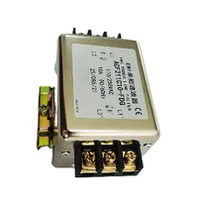
In the realm of electrical and electronic systems, noise is an ever - present nuisance. It can degrade the performance of equipment, cause malfunctions, and even pose risks to the overall stability of a system. As a supplier of 2 - line Filters, I am often asked the question: "Do 2 - line Filters reduce noise?" In this blog, we will delve into the science behind 2 - line filters, explore how they work, and analyze their effectiveness in noise reduction.
Understanding Electrical Noise
Before we can discuss how 2 - line filters work to reduce noise, it's important to understand what electrical noise is. Electrical noise refers to any unwanted electrical signals that interfere with the normal operation of an electrical or electronic system. These signals can come from a variety of sources, including electromagnetic interference (EMI) and radio - frequency interference (RFI). EMI and RFI can be generated by internal sources such as switching power supplies, motors, and digital circuits, or by external sources like radio transmitters, power lines, and lightning.
There are two main types of electrical noise: common - mode noise and differential - mode noise. Common - mode noise occurs when the unwanted signal appears on both power lines (usually the live and neutral wires) relative to the ground. Differential - mode noise, on the other hand, occurs when the unwanted signal appears between the two power lines.
How 2 - line Filters Work
A 2 - line filter is a type of electromagnetic interference (EMI) filter designed to reduce both common - mode and differential - mode noise in electrical systems. It typically consists of inductors and capacitors arranged in a specific circuit configuration.
Capacitors in 2 - line Filters
Capacitors play a crucial role in 2 - line filters. They are used to shunt high - frequency noise to the ground or between the power lines. In the case of common - mode noise, capacitors are connected between each power line and the ground. Since capacitors offer low impedance to high - frequency signals, they provide a path for the common - mode noise to flow to the ground, effectively reducing its level in the power lines.
For differential - mode noise, capacitors are connected directly between the two power lines. These capacitors short - circuit the high - frequency differential - mode noise, preventing it from reaching the load.
Inductors in 2 - line Filters
Inductors, also known as coils, are used to block high - frequency noise. They work based on the principle of electromagnetic induction. When an alternating current (AC) passes through an inductor, it creates a magnetic field. The magnetic field opposes any change in the current, and this opposition is greater for high - frequency currents.
In a 2 - line filter, inductors are placed in series with the power lines. As high - frequency noise tries to pass through the inductor, the inductor's impedance increases, effectively blocking the noise from reaching the load.
Effectiveness of 2 - line Filters in Noise Reduction
Numerous studies and real - world applications have demonstrated the effectiveness of 2 - line filters in reducing electrical noise.
Laboratory Tests
In laboratory settings, 2 - line filters are often tested using specialized equipment such as spectrum analyzers and EMI receivers. These tests measure the level of noise before and after the filter is installed in a circuit. The results typically show a significant reduction in both common - mode and differential - mode noise across a wide range of frequencies.
For example, in a test conducted on a power supply circuit with a high level of EMI from a nearby radio transmitter, the installation of a 2 - line filter reduced the common - mode noise by up to 30 dB and the differential - mode noise by up to 25 dB in the frequency range of 1 MHz to 30 MHz.
Real - World Applications
In real - world applications, 2 - line filters are widely used in various industries, including telecommunications, automotive, and industrial automation. In telecommunications, 2 - line filters are used to reduce noise in power supplies for communication equipment, ensuring clear and reliable signal transmission. In the automotive industry, they are used to reduce electrical noise in the vehicle's electrical system, which can interfere with sensitive electronic components such as sensors and control units.
Comparison with Other Types of Filters
While 2 - line filters are effective in reducing noise, it's worth comparing them with other types of filters, such as 3 Phase Filter and 3 Phase Ac Filter.
3 Phase Filters
3 phase filters are designed for three - phase electrical systems, which are commonly used in industrial applications. They are more complex than 2 - line filters and are capable of handling higher power levels. 3 phase filters can reduce noise in all three phases simultaneously, making them suitable for large - scale industrial equipment.
However, for single - phase systems or smaller applications, 2 - line filters are often more cost - effective and easier to install. They can provide sufficient noise reduction for most single - phase electrical and electronic devices.
3 Phase AC Filters
3 phase AC filters are a specific type of 3 phase filter designed for alternating current systems. They are optimized to reduce noise in AC power supplies. Similar to 3 phase filters, they are more suitable for large - scale industrial applications. 2 - line filters, on the other hand, are more versatile and can be used in a wide range of single - phase applications, including household appliances and small - scale electronic devices.
Factors Affecting the Performance of 2 - line Filters
The effectiveness of 2 - line filters in reducing noise can be affected by several factors.


Filter Design
The design of the 2 - line filter, including the values of the inductors and capacitors, the circuit configuration, and the quality of the components, can significantly impact its performance. A well - designed filter with high - quality components will generally provide better noise reduction than a poorly designed one.
Installation
Proper installation is crucial for the optimal performance of 2 - line filters. Incorrect wiring, improper grounding, or proximity to other noisy components can all reduce the filter's effectiveness. It's important to follow the manufacturer's installation instructions carefully to ensure that the filter works as intended.
Load Characteristics
The characteristics of the load connected to the filter can also affect its performance. Different loads have different impedance characteristics, which can interact with the filter's impedance. A filter that works well with one type of load may not work as effectively with another.
Conclusion
In conclusion, 2 - line filters are an effective solution for reducing electrical noise in single - phase electrical and electronic systems. They work by using capacitors to shunt high - frequency noise and inductors to block it. Laboratory tests and real - world applications have shown that they can significantly reduce both common - mode and differential - mode noise.
While they may not be as powerful as 3 phase filters or 3 phase AC filters in large - scale industrial applications, they are more cost - effective and easier to install for single - phase applications. However, their performance can be affected by factors such as filter design, installation, and load characteristics.
If you are experiencing issues with electrical noise in your single - phase electrical or electronic systems, 2 - line filters could be the solution you need. As a supplier of high - quality 2 - line filters, we are committed to providing you with the best products and technical support. If you are interested in purchasing 2 - line filters or have any questions about noise reduction, please contact us for further discussion and procurement negotiation.
References
- "Electromagnetic Compatibility Engineering" by Henry W. Ott
- "Noise Reduction Techniques in Electronic Systems" by Ralph Morrison
- Various technical reports and research papers on EMI filters from industry - leading organizations.