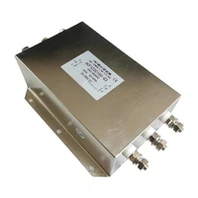
Hey there! As a supplier of Signal Line Filters, I've been getting a lot of questions lately about how these filters perform at different signal strengths. So, I thought I'd take a deep dive into this topic and share some insights with you all.
First off, let's quickly go over what a signal line filter is. In simple terms, it's a device that helps to reduce electromagnetic interference (EMI) and radio frequency interference (RFI) in electrical circuits. These interferences can mess up the quality of the signals traveling through the lines, causing all sorts of problems like data errors, noise in audio or video signals, and even malfunctions in electronic devices.
Now, when it comes to signal strength, things can get a bit tricky. Signal strength can vary widely depending on a whole bunch of factors, such as the distance between the signal source and the receiver, the type of transmission medium, and the presence of any obstacles or interference sources along the way.
Let's start with weak signals. When dealing with weak signals, a signal line filter needs to be carefully designed to minimize any additional loss of signal strength. We don't want to filter out the interference so aggressively that we end up losing the actual signal we're trying to protect. A good filter for weak signals should have a low insertion loss. Insertion loss is basically the amount of signal power that's lost when the filter is inserted into the circuit. For weak signals, we're looking for filters with insertion losses in the range of just a few decibels (dB).
Our 2-line Filters are a great option for weak signal applications. They're designed to provide effective filtering while keeping the insertion loss to a minimum. These filters are perfect for use in low-power communication systems, where every bit of signal strength counts.
On the other hand, strong signals can present a different set of challenges. With strong signals, the main concern is usually the ability of the filter to handle high power levels without getting damaged. A filter that's not rated for high-power signals might overheat or even break down when exposed to a strong signal. This can lead to a complete loss of filtering functionality and potentially damage other components in the circuit.
Our 4-line Filters are built to handle strong signals. They have a high power rating and are designed to dissipate heat effectively. This means they can filter out interference from strong signals without compromising their performance or reliability.
Another important aspect to consider is the frequency response of the filter. Different signal strengths can occur at different frequencies, and a good filter should be able to adapt to these variations. A filter with a wide frequency response can handle signals across a broad range of frequencies, which is especially useful in today's multi-frequency communication systems.
Our 3 Phase Filter is a prime example of a filter with an excellent frequency response. It can effectively filter out interference from signals at various frequencies, whether they're weak or strong. This makes it a versatile choice for a wide range of applications, from industrial power systems to telecommunications networks.


Now, let's talk about how the performance of a signal line filter can be measured at different signal strengths. One common method is to use a spectrum analyzer. This device can display the frequency spectrum of a signal, allowing us to see the strength of the signal at different frequencies and how the filter affects it. By comparing the spectrum before and after the filter is inserted, we can determine the filter's effectiveness in reducing interference and its impact on the signal strength.
Another way to measure performance is through actual field testing. We can install the filter in a real-world application and monitor the performance of the system over time. This gives us a more accurate picture of how the filter behaves under different conditions and signal strengths.
In conclusion, the performance of a signal line filter at different signal strengths depends on several factors, including insertion loss, power handling capacity, frequency response, and the specific design of the filter. As a supplier, we offer a range of filters, like the 2-line Filters, 4-line Filters, and 3 Phase Filter, to meet the diverse needs of our customers.
If you're in the market for a signal line filter and want to learn more about how our products can perform at different signal strengths, don't hesitate to reach out. We're here to help you find the right filter for your specific application and ensure that your signals are protected from interference. Let's have a chat and see how we can work together to solve your EMI and RFI problems.